• Market opens higher after global cues
• New course enrolments start next week
• IPO filing announced today
• Tips: How to build a diversified portfolio
A structured program designed for beginner and intermediate investors who want clarity on how markets work, how different asset classes behave, and how to make smarter financial decisions. This course covers market basics, key terminologies, risk principles, asset classes, and how economic forces shape investment decisions. By the end, you’ll understand not just what to invest in — but how to think like an informed, confident investor.
Investing is not about prediction — it is about clarity, structure, and behaviour. Every concept in this program has been designed to remove noise, simplify complexity, and help you think like a sensible long-term investor.
Understanding investing the right way requires more than YouTube videos or random tips — it requires a structured foundation. The GrowthBridge™ Core Investor Program guides you from essential financial concepts all the way to understanding market structure, asset classes, macro factors, risk, and practical starter portfolio construction.
This program is ideal for beginners and early-stage investors who want clarity, confidence, and a professional-grade understanding of how markets work. Concepts are taught using Indian examples, real-world scenarios, and GrowthBridge™ learning frameworks that make complex ideas simple and actionable.
By the end, you won’t just “know terms” — you’ll understand how everything connects: how returns are generated, how risks play out, and what it truly takes to invest sensibly for the long term.
Build clarity on compounding, inflation, risk, returns, and financial decision-making. Learn how investors evaluate trade-offs using simple mental models like risk–return mapping and the three dimensions of risk.
Understand how Indian markets work, how indices are built, and how index changes affect stock prices. Learn how global indices and US interest rates influence Indian markets and short-term volatility.
Learn how mutual funds, index funds, and ETFs work, how indices drive passive returns, and how to choose funds smartly. Includes real-estate market instruments like REITs/InvITs for diversified exposure.
Master essential market terms, valuations, and trading language used in news and research. Understand risk-on/risk-off phases and how shifts in sentiment impact different sectors.
Learn how bonds behave, how yields work, and why interest rates move fixed-income prices. Understand rate sensitivity, duration, and how rising/falling rates affect valuations and returns.
Understand real estate’s role in portfolios, how interest rates influence property valuations, and the various instruments available for Indian investors — including REITs and new-age fractional platforms.
Build a clear view of how economic cycles shape markets, sector rotations, and capital flows. Learn how Indian and US macro data drive market movements and how to use a cycle-aware allocation approach.
Learn practical tools to manage emotions, understand volatility, and recognise behavioural pitfalls. Includes the Asset Clarity Matrix, journaling system, and frameworks for building long-term discipline.
Integrate all concepts using simple learning models like the Market Structure Pyramid and the Investor Readiness Indicator. Build clarity on how assets interact and how to start investing sensibly.
Copyright © 2025 GrowthBridge™ Labs | All Rights Reserved
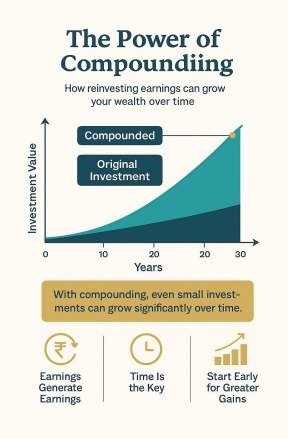
Many beginners hesitate to invest because they believe it’s only for the rich. In reality, investing is less about how much you start with and more about how early and regularly you begin. A ₹1000 SIP every month may seem small, but over 20 years at 12% annual returns, it grows to nearly ₹10 lakh — that’s the power of compounding. The Indian market, especially through mutual funds and government backed investment vehicles, has made investing extremely inclusive.
Platforms like Groww, Zerodha, and Kuvera have made SIPs accessible, removing entry barriers. The
misconception arises because older generations associated investing with large lump sums or buying real estate. But today, fractional investing and systematic plans have democratized wealth creation.
Start small, but stay consistent. The act of starting teaches you far more than waiting for the ‘perfect amount.’ Remember — you can’t compound money you haven’t invested.
GrowthBridge Insight investment.: True wealth starts with the courage to begin — not the size of your first
WhatsApp us